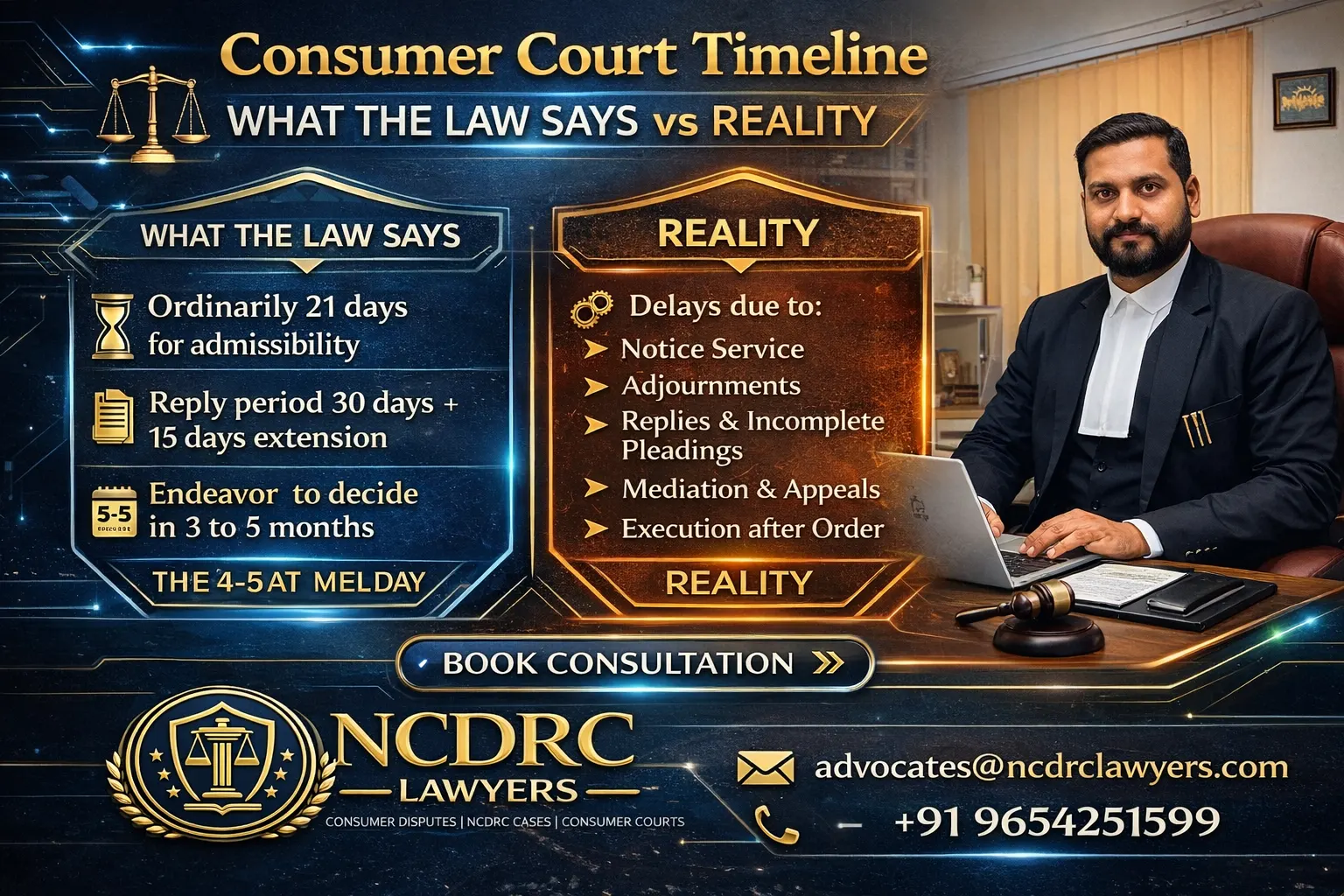
Consumer Court Timeline What the Law Says vs Reality
When people first think about a consumer case, they usually picture a simple way to get there. A complaint is filed, the company is notified, the documents are checked, the arguments are heard, and the problem is fixed quickly. The Consumer Protection Act of 2019 was supposed to make consumer justice easier to get, more up-to-date, and faster than regular civil litigation. It also made it possible for online systems, mediation, and structured appellate remedies so that people don't feel powerless against big companies or service providers.
But anyone who has actually dealt with a consumer dispute in India knows that things can be very different in real life. The law may use terms like "ordinary timelines," "quick admission," "fixed reply periods," and "digital access," but in real life, there are often repeated dates, delayed notice service, incomplete replies, settlement talks that go nowhere, and execution battles even after a favorable order. This is when strategic advice from NCDRC Lawyers and Advocate BK Singh comes in handy. The difference between a case that looks good on paper and one that is actually well managed is often what determines how long the consumer has to wait.
1. What the consumer law really says about the timeline
The Consumer Protection Act of 2019 lays out a plan that seems to be good for consumers. A complaint should usually be looked at for admissibility within twenty-one days of being filed. After the other party has been admitted, they have thirty days to file their version, which can be extended by fifteen days. The Act also sets up mediation, appeal deadlines, review powers, and commission-wise jurisdiction, so the process should go smoothly and in an orderly way.
The law also sets a limit on what it can do. Most of the time, a consumer complaint must be filed within two years of the event that led to the complaint. That sounds simple, but a lot of people put off filing because they keep waiting for customer service, internal grievance officers, brand escalations, or refund promises that never come through. The legal process has already started working against them by the time they talk to a lawyer. NCDRC lawyers and Advocate BK Singh frequently assist clients in determining the accurate cause of action date and in organizing the record prior to any delays escalating into an additional dispute within the primary dispute.
2. Where a case is filed and how choosing a forum affects time
Jurisdiction is not just a technicality. The Act says that District Commissions are in charge of complaints where the value of the goods or services paid for is less than one crore rupees. The State Commissions deal with complaints that are worth between one crore and ten crore, while the National Commission deals with complaints that are worth more than ten crore. Choosing the wrong forum can waste weeks or even months because objections about maintainability and value can slow things down before the merits are even looked at.
In real life, the choice of forum also affects how quickly hearings happen, how easy it is to travel, how well documents are filed, and how the final order is carried out. If you don't think about territorial convenience, documentary proof, and the respondent's likely objections before filing a case that is legally maintainable, it could still be inefficient. This is why consumer lawsuits aren't just about filing quickly. From the start, it's about filing correctly, with the right documents, the right value, and the right prayer. That is often the difference between making progress quickly and getting lost in the process.
3. What usually happens after you file
A lot of people think that the hardest part is filing the complaint. In reality, filing is just the first step. After being admitted, the notice must be properly delivered to the other party. Then the other party can ask for more time to respond, file a lot of paperwork, question the consumer's status, deny the deficiency, or blame a third party like a dealer, insurer, courier, builder, hospital, or platform operator. Even where the law sets reply timelines, the practical pace can still depend on service of notice, appearance, and case management.
This is why the law often seems to move faster than real life. The law says that a twenty-one-day admissibility target is something that should happen most of the time, not something that will happen in every case. In many cases, the same gap happens after admission. The paper timeline looks good, but the actual movement depends on how quickly the case is listed, how well the respondent is served, and whether the file is complete enough to avoid having to make changes to the procedure over and over again.
4. The role of mediation and how it can help or hurt your time.
The 2019 Act officially recognizes consumer mediation and sets up consumer mediation cells that are linked to commissions. The commission can send the case to mediation if both parties agree in writing. The framework lets the dispute be settled without a full adversarial contest. Mediation can save months of court cases in the right situation, especially when the main issue is a delayed refund, limited compensation, replacement, warranty honor, settling billing disputes, or delivery failure.
Not every mediation referral is good for the consumer, though. Some companies only use settlement language to buy time, ease pressure, or avoid having a strong written order on file. A good lawyer knows when mediation is really helpful and when it's just another place to wait. Advocate BK Singh and the NCDRC Lawyers team usually see mediation as a tactical step, not a ritual one. This way, the client doesn't waste time trying to reach a compromise that the other side never really meant to keep.
5. The digital promise and the real change in how filing systems work
Digital filing has had a big impact on how people do things. Official consumer systems have made it possible to file complaints, pay fees, exchange documents, track progress, and access platforms online. This was first done through e-Daakhil and then through the larger e Jagriti framework. Government documents have said that these systems can help cut down on paperwork, make things easier to find, support virtual participation, and speed up the process of getting rid of things.
But digital reform doesn't always get rid of delays. Even if you can file online, the real speed still depends on how well you keep track of your listings, serve notices, check documents, manage hearings, and carry out the final order. In fact, official workshops and public updates have talked about quick disposal, cutting down on adjournments, hybrid hearings, and stronger compliance mechanisms. This shows that delay and post-order enforcement are still problems in the system.
6. What the law says about appeals and why cases take longer than they should
Another place where clients' expectations and the law often don't match up is in appeals. You can appeal orders from the District Commission to the State Commission, orders from the State Commission to the National Commission, and some orders from the National Commission to the Supreme Court. The Act says that appeals must be filed within thirty days, but delays are okay if there is a good reason for them. In some cases of appeal, it also requires a deposit of fifty percent of the ordered amount, which can have a big impact on what the respondent does next.
For customers, this means that winning the first round may not mean the end right away. A business that wants to keep the disagreement going can appeal, ask for temporary relief, negotiate informally, or put off following the rules until it has to take coercive action. This is one reason why experienced lawyers don't just tell their clients how to get an order. They tell them how to make it hard to get around that order. In consumer issues, the timeline is more than just the complaint. It's also about what happens after the complaint.
7. The biggest difference between the legal timeline and the real timeline
The simplest thing is the biggest gap. The law talks in stages, but life gets in the way. People who complain usually have clear stories, like a delay in getting their flat, a broken car, a denied insurance claim, a failed medical service, hidden banking fees, overcharging on telecom, a canceled trip, a fake online sale, a dispute over education services, or a builder refund delay. But commissions make decisions based on evidence, the order in which events happened, their authority, time limits, and proof of lack. If the file is weak, being sure of your feelings doesn't help you get things done faster. It usually makes it worse.
That's why complaints that are well thought out tend to get more attention than complaints that are rushed. A well-organized set of invoices, emails, screenshots, legal notice records, payment trails, expert reports if needed, and a sharp prayer can help keep the case on track. A vague complaint leads to a vague defense and a longer fight. Clients often choose NCDRC Lawyers and Advocate BK Singh for these kinds of cases because they need more than just legal language; they need help putting their case together. Most consumer delays get worse when the complaint isn't clear, makes too many claims, or isn't well documented.
8. How customers can really cut down on delays
A customer can't control the whole system, but they can control a lot of it from the start. File within the limits. Keep all of your invoices, emails, chats, refund guarantees, service request numbers, and proof of transactions. When it's right, send a clear legal notice. Find the right value. Don't raise pay without thinking it through. Be ready for mediation, but only if the terms are clear. Instead of assuming the company will follow the order, push for compliance after the order is given. These steps aren't very exciting, but they do save time.
The truth is that Indian consumer law does offer a strong remedy, but it takes time, planning, and persistence to get it. The law sets the framework. Reality checks the execution. That gap can be tiring for middle-class families, salaried workers, pensioners, homebuyers, policyholders, online shoppers, and small business owners. This is where NCDRC Lawyers and Advocate BK Singh help by turning a stressful complaint into a structured legal process with clear next steps, realistic expectations, and a plan that works for both relief and enforcement.
Reviews from Clients
*****
Rakesh Malhotra
I thought my consumer case would be over in a few months, but the company kept putting it off, and I started to lose faith. Advocate BK Singh was honest about the timeline, helped me fill out my papers correctly, and made sure I knew what the law says and what really happens in commission cases. That clarity alone took away half of my stress. I thought that the NCDRC lawyers were patient and had a real plan for the case.
*****
Sunita Verma
I thought my case was already weak because I only had emails and partial payment proof, and the dispute over my refund had been going on for a long time. NCDRC Lawyers reorganized the file in a way that made my complaint look right. Advocate BK Singh was calm, straightforward, and useful. I never got false promises, just good advice, which made me trust the process again.
*****
Amit Deshpande
I asked for help with a service problem after spending months with customer care and escalation teams. What I liked best was that Advocate BK Singh didn't try to make the case sound bigger than it was right away. Instead, he focused on the limits, the forum, and the documentary proof. The advice was clear and to the point. I felt supported at every step, and I finally had someone who knew how things really work in the world of consumers.
*****
Farah Naqvi
As a working person, I needed a legal team that would respect my time and make sure I understood each step. That's exactly what NCDRC Lawyers gave me. The company kept making excuses, not responding, and taking too long to respond to my case. Advocate BK Singh took the case seriously and kept the approach fair and useful. I felt like my voice was heard, I was informed, and I was safe under the law.
*****
Girish Patel
I was shocked by how much better a consumer case can be with proper legal drafting. I thought my complaint was easy before I got legal help, but I didn't know how valuation, relief, and supporting papers would affect the timeline. Advocate BK Singh gave very useful advice and handled the case in a very professional way. The NCDRC Lawyers team made me feel like my case was finally going in the right direction.
?FAQs
Q1. How long does a case in a consumer court in India take?
The legal system is meant to move faster than regular civil litigation, but how long it takes depends on things like admission, notice service, reply filing, evidence, hearing dates, and execution. Some early steps are supposed to happen within set time frames, but in reality, many things take longer than consumers think they will.
Q2. How long do you have to file a complaint as a consumer?
In most cases, a complaint must be filed within two years of the event that caused it. Many customers waste a lot of time waiting for the company to keep its promises, so it's important to get legal advice early on.
Q3. Can I make a complaint online?
Yes. Official consumer systems let you file online and keep track of your case. Digital consumer justice tools like e-Daakhil and e-Jagriti were made to help people file complaints and keep track of them.
Q4. How fast should the commission accept a complaint?
The Act says that the decision on whether something is admissible should usually be made within twenty-one days of the filing date. The word "ordinarily" is important because the actual listing and review can still be different in practice.
Q5. How long does the other party have to file a response?
The other party usually has thirty days to give their side of the story, but they can ask for an extra fifteen days. This is one of the most important timeline rules that customers should know.
Q6. Which consumer commission should I talk to?
That mostly depends on how much the goods or services are worth. The District Commission takes care of cases worth up to one crore rupees, the State Commission takes care of cases worth more than one crore but less than ten crore, and the National Commission takes care of cases worth more than ten crore.
Q7. Can mediation be used in consumer cases?
Yes. The Consumer Protection Act of 2019 lets people go to mediation when both sides agree. It also sets up consumer mediation cells. Mediation can save time and money in the right kinds of refund and service disputes.
Q8. What happens if I win and the company still doesn't do what I want?
A good order is important, but it may still be necessary to take more legal steps to enforce it. This is one reason why a consumer litigation strategy should include both relief and compliance after the order is made from the start.
Q9. Can a business fight a decision made by a consumer court?
Yes. The law lets people appeal decisions from the District to the State Commission, from the State to the National Commission, and in some cases, from the National Commission to the Supreme Court, usually within thirty days, as long as certain conditions are met.
Q10. Why do cases involving consumers take longer than expected, even though the law seems to move quickly?
The legal timeline is just one part of the whole process. Notice problems, incomplete pleadings, adjournments, settlement tactics, a lot of work, and compliance disputes after the order are all common causes of delays. Good paperwork and a clear legal plan usually help avoid delays that aren't necessary.
There's no reason for concern. There is no difficult-to-understand legalese.
Someone who has helped many people with the same problems gives you clear, honest advice. We want to make the legal process easy to understand and use for everyone.
