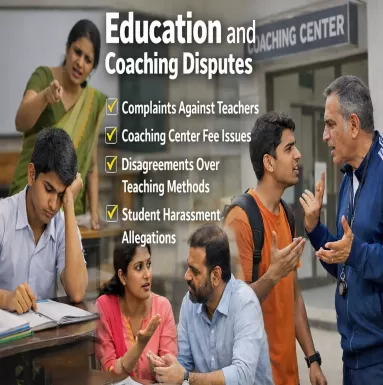
Education and Coaching Disputes
Education and coaching disputes often happen when students or parents think that the services promised by a school or coach don't match what they actually get after they sign up. Families all over India spend a lot of money on coaching centers, professional training institutes, entrance exam preparation programs, and skill-based courses in the hopes of getting better job or school opportunities. Things start to go wrong when schools won't give back fees, suddenly change teachers, stop classes in the middle, or don't provide the facilities and study help that were promised during admission. This situation causes emotional stress and financial loss for many middle-class families, especially when they planned and sacrificed to pay for their children's education.
A lot of people don't think about legal options at first because they think they can't fight disputes with coaching institutes or training centers. But if a coaching institute offers a service for a fee and doesn't deliver what was promised, the situation could be considered a service deficiency. In these situations, a coaching refund consumer complaint or an education service deficiency consumer case can be a valid legal option. NCDRC lawyers often help students and parents deal with these problems by using smart and careful legal strategies. Advocate BK Singh has helped families understand how to properly document the dispute, go to the right consumer commission, and avoid unnecessary legal confusion.
1. Common issues that come up in disputes over education and coaching
Disagreements about education often happen when schools make big promises during admission counseling but don't follow through after getting full payment. Students often say that classes start late, teachers change a lot, study materials are never finished, or online help that was promised during admission never comes through. Another common problem happens when coaching centers aggressively market guaranteed results, rank improvement programs, or placement support but then refuse to take responsibility when the expected outcome doesn't happen. These situations make students feel like they were tricked and put a lot of stress on their finances.
Another big problem is refusing to give back money. Many schools have strict refund policies in their admission forms that students sign quickly without really understanding what they mean. The school won't give back the fees if a student drops out later because of bad service, health issues, moving, or false promises. These disagreements often lead to coaching refund complaints from customers because the service they paid for was either not delivered or delivered in a way that was far below what they expected. Families can get help from Advocate BK Singh to figure out if their case is an education service deficiency consumer case and how to move forward with the right paperwork.
2. When a person can file a complaint against a coaching center
If a coaching institute or private training center charges for educational support but doesn't deliver the promised level of service, a customer may be able to file a complaint. If ads promise certain things like facilities, faculty expertise, course length, or specialized preparation and those promises are not kept, the student may have a reason to challenge the school. Consumer commissions look into whether there was unfair trade, false advertising, or a clear lack of service. Many successful education disputes have been settled when students showed admission brochures, payment receipts, and communication records that showed the school didn't do what it said it would do.
But each case needs to be looked at carefully because not all complaints about education are handled the same way. Some issues involving universities and government-run schools may not be covered by consumer law, but many issues involving coaching centers, skill training programs, online coaching platforms, and private test prep schools can still be considered consumer service disputes. This is where it helps to have someone who has done this before. NCDRC Lawyers and BK Singh Advocate often help clients figure out if it is legal to file a coaching refund consumer complaint and which consumer commission should handle the case.
3. The role of paperwork in cases of poor education service
Strong documentation is often what makes or breaks an education dispute. Students who keep their admission forms, brochures, WhatsApp messages, emails, fee receipts, class schedules, and promotional materials usually do better in a consumer case. These records show what the institute said it would do and whether it actually did it. Written marketing claims are often very important pieces of evidence in coaching disputes because they show what was expected during admission.
Sadly, many families only trust what they hear during counseling sessions. When disagreements happen later, it can be hard to prove the original promises. A careful legal strategy, then, is to get every document that shows the agreement between the student and the school. NCDRC lawyers and Advocate BK Singh often help clients put these papers in the right order so that the complaint clearly shows how the school's actions caused the student to lose money, waste time in school, and feel stressed.
4. Problems with getting a refund and unfair rules at coaching institutes
A lot of complaints from people who buy education products are about refunds. A lot of coaching schools write on their admission forms that fees are not refundable in any case. Consumer forums sometimes look at whether these kinds of clauses are fair or unfair based on the service that was actually provided, even though they may seem strict. If classes never started, the facilities were not as described, or the institute suddenly changed the structure of the course, a strict no refund clause may not always protect the institute.
Another problem comes up when schools charge too much for administrative work or impose hidden fees when a student drops out early. If these deductions seem unfair compared to the service that was actually provided, they may be able to be challenged. In a number of coaching refund consumer complaint cases, consumer commissions have looked into whether the institute was fair and open when it came to student withdrawals. With the help of BK Singh Advocate, families can clearly explain the refund dispute and why the institute's policy put an unfair financial burden on them.
5. Complaints about online coaching and digital education
There is now a new type of coaching dispute because of the rise of online education platforms. Students often sign up for online courses after seeing ads that promise expert help, interactive classes, recorded lectures, and special sessions to clear up any questions they have. But when the actual platform has limited interaction, old recordings, or little academic support, people complain a lot. After paying, students may also have trouble getting to course materials or run into technical problems that make it hard to learn.
These online disagreements still involve paid services, so if the platform doesn't deliver what it promised, the consumer may be able to file a complaint. Screenshots of promotional pages, payment receipts, problems with logging in, and conversations with support teams are all examples of evidence that can help prove that the service was not up to par. Lawyers from the NCDRC and Advocate BK Singh look over these digital records very carefully to see if the student's complaint can be made into a consumer case about a lack of education services before the right consumer commission.
6. How coaching disagreements affect students and their families
Disputes over education affect more than just money; they also affect a student's academic future. If a coaching institute doesn't provide good preparation, the student could lose a whole exam cycle or school year. The stress of wasting time, taking the same tests over and over, and not knowing what will happen in the future can be very hard on both the student and the family. When the institute won't admit there is a problem, parents who put their savings into coaching programs often feel helpless.
This is why legal action is sometimes needed to get a refund and to make sure that service providers are held accountable. Consumer commissions give students a chance to talk about how misleading ads or bad service affected their academic progress. With the help of NCDRC lawyers and BK Singh Advocate, many families learn more about their rights and what they need to do to get a fair resolution without making the situation worse.
7. How legal help can help settle disagreements about school
In legal support for education disputes, the goal is to be clear, keep records, and communicate strategically, not to confront each other right away. In many cases, a well-written legal notice can make coaching institutes rethink their strict refund policies or come to a fair settlement. When problems get worse, a well-prepared consumer complaint can lay out the facts in a way that makes it clear to the commission what the service problem is.
Clients often find it helpful to get structured advice on how to frame the dispute, what evidence to present, and how to respond to the institute's arguments. NCDRC lawyers pay close attention to the details of these cases so that students don't accidentally hurt their own case by not providing all the information they need or making statements that don't match up. Advocate BK Singh's experience with consumer issues helps clients feel more confident and clear about the legal process.
Reviews from Clients
*****
Raghav Bansal
When the coaching school changed the teachers and the schedule for the course, I was very confused when they wouldn't give me back my money. BK Singh Advocate made the law easy to understand and walked me through the steps of the consumer complaint process. During a stressful time, the advice was helpful and calming.
*****
Mehul Chaudhary
My son signed up for a coaching program that promised personal mentoring and daily test analysis, but those services never began. We went to NCDRC Lawyers after the institute turned down our request for a refund. Advocate BK Singh looked over our papers carefully and helped us in a calm and organized way.
*****
Ankit Sabharwal
When the institute stopped classes halfway through the course, we felt powerless. The institute's messages got very defensive and hard to understand. BK Singh Advocate took the time to look over all of the admission papers and explain our rights in cases of lack of education services.
*****
Ritesh Arora
For months, the coaching center put off giving us our money back. I got in touch with NCDRC Lawyers for help and they gave me clear instructions on how to put the evidence together and talk to the school. Advocate BK Singh explained the consumer forum process in a way that made sense and made us feel good about moving forward.
*****
Karanveer Sethi
The school wouldn't give my daughter back even a small part of her fees when she dropped out of a class because of false promises. We finally understood how consumer law can apply to coaching disputes after talking to BK Singh Advocate. The advice was professional and realistic, and it didn't make any false promises.
?FAQs
Q1. Is it possible for a student to file a complaint against a coaching institute to get their money back?
Yes, a student can file a consumer complaint in many cases if the coaching institute charged them for a service but didn't deliver what they promised. If ads, brochures, or admission counseling made promises that were not kept, the case may be a service deficiency dispute.
Q2. What papers do you need to file a complaint about a coaching refund?
Important papers are usually things like admission forms, receipts for fees, brochures, ads, emails, and any written statements the school made during enrollment. These documents help show what the institute promised to do and if it kept those promises.
Q3. Does consumer law cover all disagreements about education?
Not every disagreement about education is automatically a consumer issue. But depending on the facts and the contract, many cases involving private coaching institutes, training centers, and online coaching services can be considered consumer service disputes.
Q4. How long does it take for a person to file a complaint against a coaching institute?
The length of time it takes depends on how complicated the dispute is and which consumer commission is in charge of it. Having the right paperwork and a well-written complaint can help things go more smoothly and cut down on delays that aren't needed.
Q5. Can people who use online coaching platforms also complain?
Yes, consumers may complain about online education platforms that charge for courses but don't deliver the promised services. Payment records, screenshots, and messages with the platform can all help the case.
Q6. What if the school says the fee is not refundable at all?
A strict "no refunds" clause doesn't always end the argument. Consumer commissions may look into whether the institute really did what it said it would do and if the refund policy was fair in this case.
Q7. Can parents make a complaint for their child?
Yes, parents often file complaints when the student is a minor or when they paid for the coaching. The complaint should make it clear how the student, the parents, and the school are connected.
Q8. What kind of money can a student ask for in an education dispute?
A student may ask for a refund of fees, compensation for mental stress, and reimbursement of costs caused by the service not being up to par, depending on the case. The exact amount of help depends on the evidence given.
Q9. Do you need to send a legal notice before making a complaint as a consumer?
A legal notice isn't always necessary, but it can be useful. A clear notice may make the institute more likely to respond or settle the issue before it goes to the consumer commission.
Q10. How can a lawyer help with problems in education and coaching?
A lawyer can look over papers, figure out if the case is a consumer dispute, write the complaint correctly, and help the client through the steps of filing and presenting the case.
Are you having a legal problem in Education and Coaching Disputes? You don't have to deal with it alone. Let's discuss your situation and explore the appropriate approach to handle it.
There is no pressure or difficult legal language, only clear information based on the circumstances of your Education and Coaching Disputes matter.
Chat on WhatsApp +91-9654251599Schedule Your Consultation
