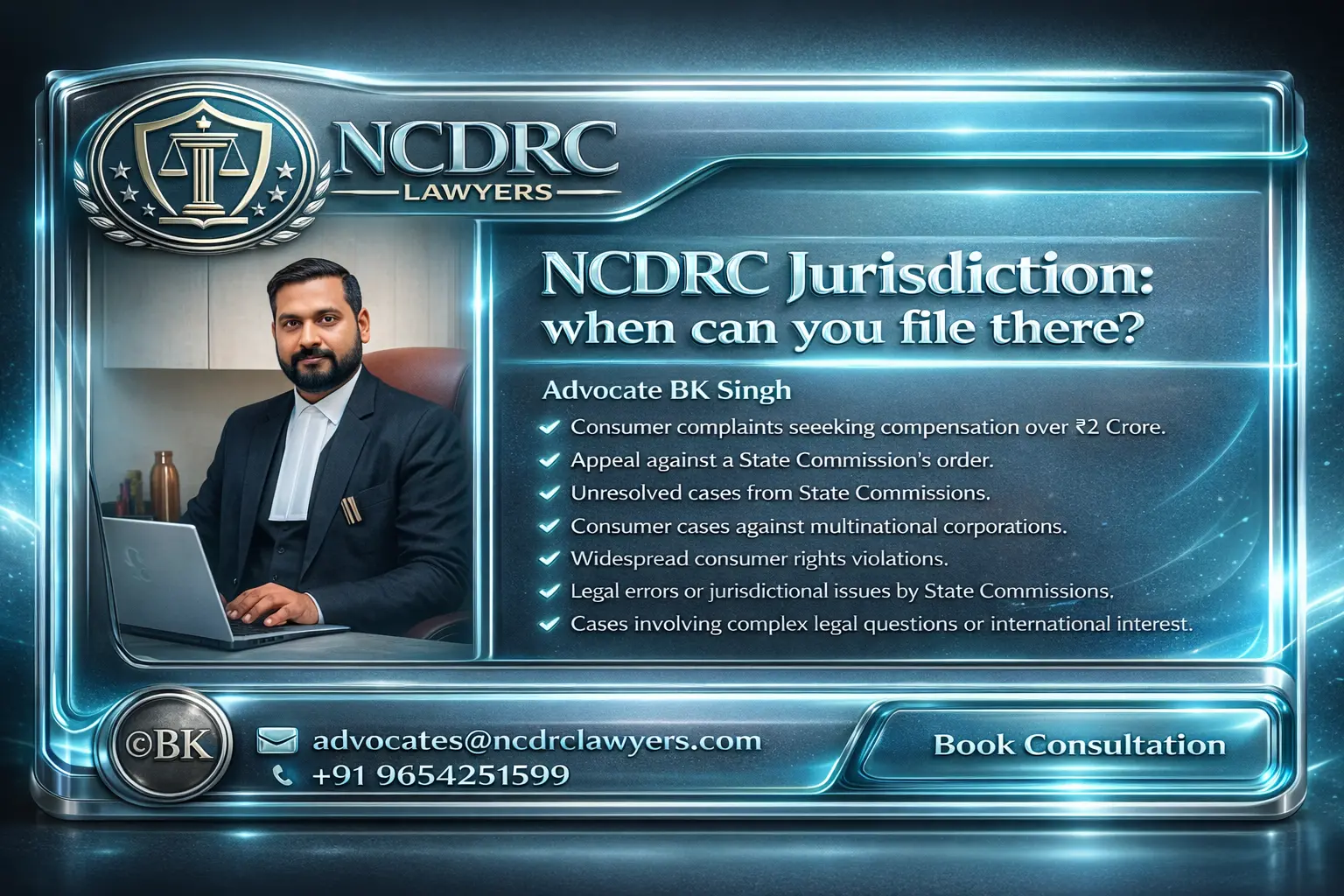
NCDRC jurisdiction when can you file there
A lot of people in India only hear about the National Consumer Disputes Redressal Commission when a builder is late, an insurance claim is denied, a hospital is negligent, a defective service claim is made, or a big refund fight gets serious. The first thing you need to know is that NCDRC is not the place to go for every complaint from a customer. According to the rules for jurisdiction in 2021, a regular consumer complaint can be filed with the National Commission if the value of the goods or services paid for is more than Rs 2 crore. If the amount paid is more than Rs 50 lakh but less than Rs 2 crore, it usually goes to the State Commission. If the amount paid is less than Rs 50 lakh, it usually goes to the District Commission.
This is why choosing a forum is more of a strategic move than a simple task. If you file a complaint with the wrong commission, it can take months to get it back on track with objections, transfers, and new filings. NCDRC also has the power to hear appeals and revisions, so some cases don't come to it as new complaints but as appeals from State Commissions or as revision petitions against mistakes in jurisdiction. Before deciding if the National Commission is the right place to go, NCDRC lawyers and Advocate BK Singh usually check the amount paid, the type of dispute, the type of relief sought, and the stage of the case.
1. When can you go straight to the NCDRC?
When your case is an original consumer complaint and the value of the goods or services paid as consideration is more than Rs 2 crore, you can file directly with NCDRC. The Consumer Protection Rules that were published on December 30, 2021, set this as the current monetary limit. In real life, this can be important in disputes over expensive homes, high-end insurance, big service contracts that people use, expensive medical treatment disputes, or other big consumer transactions where the money paid crosses that line.
This is a simple way to think about it. If a homebuyer has paid Rs 2.35 crore to a developer and says that there was a delay, poor service, or unfair behavior, they may be able to file a direct complaint with the NCDRC for an ordinary complaint. But if the same buyer paid Rs 1.80 crore, the case would usually go to the State Commission instead of the National Commission. This one important issue often determines the whole filing strategy right from the start.
2. What amount is important for the NCDRC's jurisdiction?
In today's consumer law, the rules about jurisdiction are based on how much the goods or services are worth. That wording is important because a lot of people think they can go straight to the NCDRC just by adding a big claim for damages, mental pain, or interest. The current rules for 2021, on the other hand, tie ordinary complaint jurisdiction to the amount paid for the goods or services.
This means that before clients choose the forum, they need to look over their payment records, such as receipts, payment schedules, invoices, allotment statements, policy premiums, treatment bills, service charges, or other records. A person may think the total loss is much bigger, and that may be true, but the first step in choosing a forum is still the statutory jurisdiction test. One reason NCDRC lawyers and Advocate BK Singh often want full payment documents before writing the complaint is that they need to know exactly what was paid before they can choose the right forum.
3. What about complaints about unfair contracts?
Many people, including some people who are suing, don't realize that there is an important exception. The Act gives the State Commission the power to handle complaints about unfair contracts where the goods or services paid for are worth less than Rs 10 crore. The National Commission handles complaints about unfair contracts where the value of the goods or services paid for is more than Rs 10 crore. So, when it comes to unfair contract issues, the law still uses a different set of rules than the usual complaint rules.
In simple terms, a dispute over an unfair contract usually has terms that are very unfair to the consumer, like harsh cancellation clauses, unfair penalty terms, or unfair conditions that are hidden in the contract. If the consumer wants to fight an unfair contract and the amount paid is more than Rs 10 crore, the NCDRC is the right place to do that. The State Commission may be the right place to go if the amount paid is less. This difference is important because a lot of high-value contract complaints get filed incorrectly when the type of complaint isn't clearly stated when the complaint is written.
4. When does an appeal bring a case to the NCDRC?
NCDRC is more than just an original forum. It also hears appeals against orders made by State Commissions. Section 51 of the Consumer Protection Act says that if someone is unhappy with an order from the State Commission in its original jurisdiction, they can appeal to the National Commission within 30 days of the order. The Act also says that the National Commission will not hear the appeal if the appellant has to pay any amount under the State Commission order and that amount is not deposited in the right way.
This role as an appellee is very important for both consumers and businesses. Many people first take their case to the State Commission and then to the NCDRC because the State Commission's decision was wrong in terms of facts, law, or both. In certain appellate cases, the National Commission may also consider an appeal from a decision made in an appeal by a State Commission if the matter involves a significant legal question. That makes NCDRC a real place to get things fixed, not just a higher office in Delhi.
5. When can you ask NCDRC for a revision?
The National Commission also has the power to change things. In a consumer dispute that is before or has been decided by a State Commission, it can call for records and issue appropriate orders if it seems that the State Commission acted outside of its legal authority, didn't act when it should have, or did something illegal or with serious irregularity while acting in its authority. This is not the same as a normal appeal.
A revision petition is usually the right way to go when the complaint is not just that the order is wrong on its face but that the State Commission went too far, ignored a basic jurisdiction issue, or made a serious mistake in the way it handled the case. In practice, this difference is important because starting the wrong kind of case can make it weaker before it even starts. So, a careful lawyer will look at whether the challenge is really related to an appeal, a revision, or a review before telling someone to file with the NCDRC.
6. Who can file and when
Under the Act, a consumer can file a complaint not only on their own but also through a recognized consumer association, with the permission of one or more consumers with the same interest, and in some cases, the Central Government, Central Authority, or State Government. The Act also lets people file complaints online, but they have to pay the required fee with the complaint. A lot of people think that this makes the process harder, but it actually makes it easier.
Another place where people lose strong cases is in the area of limitation. Section 69 says that the District Commission, State Commission, or National Commission cannot accept a complaint unless it is filed within two years of the event that led to the complaint. However, complaints that are filed later can still be heard if there is a good reason for the delay and the reasons are documented. So, if a client waits too long after a possession delay, an insurance claim denial, a refund denial, or a service denial, forum selection alone won't help the case.
7. Can you file online, and does where you are still matter?
The Central Government has made it clear that people can file complaints online and that the E Daakhil system was made to make filing easier, faster, and less reliant on being there in person. For many people who live outside of Delhi, this is useful because it means that paperwork, notices, hearing information, and other updates can be sent through a structured digital system instead of just being filed in person.
The Act clearly states that there are territorial hooks at the District and State levels. These include where the other party lives or does business, where the cause of action arose, or where the complainant lives or works for money. The NCDRC is the national level and can also move complaints from one District Commission in one state to another District Commission in another state, or from one State Commission to another, when it is in the interest of justice. This is important when a disagreement has to do with more than one state or when there are concerns about where the case should go next.
8. How to tell if NCDRC is the best place for your case
The practical test is easy to do. First, find out if your complaint is an original one, a matter of an unfair contract, an appeal from a State Commission order, or a revision against a jurisdictional error. Check the amount paid as consideration and the time frame from the cause of action. If the original complaint is normal and the amount paid is more than Rs 2 crore, the NCDRC may be the right place to go. The Rs 10 crore line is very important if the complaint is about an unfair contract. The 30-day period and deposit requirement are just as important if it is an appeal.
For middle-class families and small business owners who have a lot of money tied up in housing, insurance, health, education, travel, or service transactions, picking the right consumer forum can change the speed and direction of the whole dispute. That's where careful writing, looking over payment records, reviewing limits, and planning for relief are most important. NCDRC Lawyers and Advocate BK Singh can help clients file in the right place, frame the right cause of action, and avoid procedural mistakes that can delay real consumer relief. They don't need to make big promises.
Reviews from Clients
*****
Raghav Sethi
I wasn't sure if my builder case should go to the State Commission or the NCDRC because the amounts were high and the papers were hard to understand. Advocate BK Singh made the jurisdiction issue clear, went over every payment receipt carefully, and helped me understand what was important from a legal point of view. The advice was useful and honest, which made me feel calm for the first time.
*****
Meenal Arora
I had already wasted time getting different opinions from different people about my consumer dispute, which was a big insurance claim. The NCDRC Lawyers team made it clear what I needed to do, told me what papers I was missing, and explained how choosing a forum could change the whole case. That clarity kept me from making a mistake.
*****
Vikram Malhotra
I went to NCDRC Lawyers when my case reached a point where it was important to come up with an appeal strategy. Advocate BK Singh was calm, straightforward, and very focused on documents instead of making empty promises. What I liked best was that the case was being handled with discipline and not drama.
*****
Shalini Batra
I had never worked with a national consumer forum before, and the process made me nervous. The advice I got was clear, polite, and easy to follow. They talked about limitations, jurisdiction, and the order in which to file in a way that made me feel like I understood rather than confused.
*****
Prateek Nanda
I didn't want to waste time by filing in the wrong place because my case was worth a lot of money. BK Singh Advocate looked over the papers, quickly pointed out the most important legal issue, and helped me understand the pros and cons of my case. I trusted the process because the advice seemed solid and professional.
?FAQs
Q1. What is the current monetary jurisdiction of NCDRC in India?
Under the 2021 jurisdiction rules, the National Commission now has jurisdiction over a regular original consumer complaint if the value of the goods or services paid for exceeds Rs 2 crore.
Q2. If I've lost a lot of money, can I file directly in NCDRC?
Not all the time. The statutory jurisdiction test, which looks at the value paid as consideration and the type of case, is what determines whether direct filing is possible. Just because you have a big complaint doesn't mean that the NCDRC will automatically hear it.
Q3. What if my case is about a contract that isn't fair?
The Act gives the National Commission separate authority over unfair contract complaints when the value of the goods or services paid for exceeds Rs 10 crore. The State Commission may be the right original forum if it is lower.
Q4. Can the NCDRC hear an appeal from the State Commission?
Yes. Within 30 days, a person who is unhappy with a State Commission order can appeal to the NCDRC. This is subject to the conditions set out in Section 51, which include the need to pay a deposit if an amount is ordered to be paid.
Q5. How long do you have to file a complaint with NCDRC?
The general time limit is two years from the day the cause of action happened. If there is a good reason, the Commission may still allow a delay.
Q6. Is it possible to file a consumer complaint online?
Yes. The Act allows electronic filing, and the Central Government has also promoted the E Daakhil platform to make it easier for people to file complaints online.
Q7. Who can make a complaint under the Consumer Protection Act?
The consumer, a recognized consumer association, one or more consumers with the same interest and permission, or the Central Government, Central Authority, or State Government in the right circumstances can file a complaint.
Q8. Can the NCDRC step in if the State Commission did something without the right authority?
Yes. NCDRC has the power to review cases where the State Commission did not have the authority to do so, did not do so, or did so illegally or with a serious mistake.
Q9. What do I do after the NCDRC gives me an order?
Within 30 days of the National Commission's original decision, an appeal can be made to the Supreme Court, as long as the law allows it.
Q10. How do I know if I should file with the District Commission, the State Commission, or the NCDRC?
The current rule is that the District Commission can handle complaints up to Rs 50 lakh, the State Commission can handle complaints between Rs 50 lakh and Rs 2 crore, and the NCDRC can handle complaints over Rs 2 crore. Before filing, it's important to review the documents because the type of case, like an unfair contract, can change the right forum.
There's no reason for concern. There is no difficult-to-understand legalese.
Someone who has helped many people with the same problems gives you clear, honest advice. We want to make the legal process easy to understand and use for everyone.
