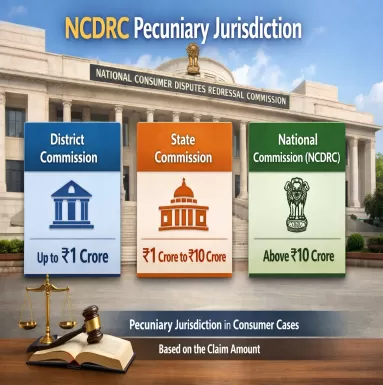
NCDRC Pecuniary Jurisdiction
A lot of people only hear the term "NCDRC pecuniary jurisdiction" after a problem has gotten really bad, but this is something that should be understood from the start of a consumer case. To put it simply, pecuniary jurisdiction is the amount of money that will determine whether your complaint should go to the District Commission, the State Commission, or the National Consumer Disputes Redressal Commission. If someone files in the wrong place, the case could be delayed, objected to, and cost more money, which is especially hard for middle-class families and small business owners who are already having money problems.
When people search for this topic, they usually want to know if the National Commission's 2 crore rule applies to their complaint and how the case value is figured out. People often ask this question when they are in a housing dispute, filing an insurance claim, complaining about bad service, medical negligence, delayed possession, or a high-value refund dispute. NCDRC lawyers help clients with this first and most important step all the time. Clients often go to Advocate BK Singh for a clear answer before spending time and money on litigation.
1. What does "NCDRC pecuniary jurisdiction" really mean?
NCDRC pecuniary jurisdiction is the amount of money that the National Commission can hear a consumer complaint about. It is not just based on how you feel, how hard it is, or how serious the disagreement is. It depends on the monetary value that is legally relevant to the complaint. That value will tell you if the National Commission is the right place to file the complaint. This is one of the most confusing parts of consumer law for regular people because a lot of people mix up the claim amount, the compensation demand, and the actual amount paid.
This confusion gets worse when people use old internet content, old legal advice, or incomplete information from social media. Some people may think that just asking for a lot of money will make the case fit before the National Commission, but that's not how forum selection should work in real life. Before writing the complaint, it is important to carefully read the legal definition of the monetary threshold. That's why BK Singh Advocate usually looks at documents, proof of payment, the value of the agreement, and the exact nature of the transaction before telling a client which consumer forum to use.
2. The National Commission's 2 crore rule of jurisdiction
Right now, most people think that the National Commission jurisdiction 2 crore rule means that cases that go over the limit can be taken to the NCDRC. This is a very important topic for people buying homes, investors in big service contracts, families whose insurance claims are being denied, and businesses that are losing a lot of money because of unfair trade practices or poor service. Even a small mistake in choosing the forum can cause months of procedural delays if the amount of the transaction is large.
For this reason, clients should never think that every costly disagreement automatically goes to the National Commission. You need to carefully figure out the real value of the case based on how much you paid and what goods or services were involved in the complaint. Someone may have lost a lot of money in real life, but the legal question is whether the complaint meets the NCDRC's financial threshold for filing. NCDRC Lawyers deals with this problem by using a documentation-based approach so that clients don't start their consumer lawsuits from the wrong legal point.
3. How people usually think about the value of a customer complaint
People often want to know if the case value only includes the price paid or if compensation, interest, mental harassment, and court costs should also be added. This question is often what makes people choose a forum. In real life, lawyers look at the transaction papers, receipts, allotment letters, invoices, insurance policy records, bank statements, and service agreements to figure out how much money is really involved in the complaint. Without that exercise, any decision to file directly could be dangerous.
For example, a buyer who paid a builder a lot of money for a flat but didn't get it on time. The buyer may want a refund, interest, and compensation for stress, rent, and delay, but the first step in the legal process is to figure out what amount is most important for deciding jurisdiction. In an insurance dispute, the value may seem very high because of how it affects the insured person's finances, but the legal forum question still needs careful calculation. Advocate BK Singh often helps clients by separating emotional loss from forum value so that the complaint has a stronger procedural basis.
4. Why filing in the wrong place causes big delays
A lot of people think that filing quickly is more important than filing correctly, but in consumer litigation, the two should go together. If a complaint is filed with the wrong commission, the other party can quickly raise an objection based on pecuniary jurisdiction. After that, the person who complained may have to spend more time arguing about whether the case can go forward before it can even move on to the merits. This is one of the most annoying things that can happen to customers because the real issue isn't being heard while the case is stuck on forum selection.
This issue hurts middle-class people who are suing the most because they usually save up money for legal action and expect the complaint to start moving soon after it is filed. If they have to redo the pleadings, change the strategy, or file again, it will be harder on them emotionally and financially. Small business owners also suffer because disputes between customers can stop cash flow and make it hard to plan for the future. Because of this, NCDRC Lawyers places a lot of importance on the jurisdiction stage itself. To avoid this kind of unnecessary procedural loss, they often consult with BK Singh Advocate.
5. Common disagreements where NCDRC jurisdiction is important
NCDRC's financial jurisdiction is often important in complaints about high-value real estate, delayed possession issues, cancellation refund disputes, medical negligence cases involving expensive treatment, major insurance rejection cases, defective luxury products, and service failures involving large payments. In a lot of these cases, the customer has already spent a lot of money and now wants a strong forum that can hear the case properly. People also look up this topic when they get different advice from agents, customer service teams, or local advisers who don't fully understand the limits of consumer forums.
For instance, a family might put their savings and loans into a home and later find out that the construction is taking longer than expected, that they were promised something that never happened, or that they can't get their money back. Another customer might pay for a high-value health policy or business service for years and then have their claim denied. People often look up things like "NCDRC complaint value," "National Commission jurisdiction 2 crore," or "who can file in NCDRC" to get more information before moving forward. A smart lawyer doesn't write first and think later. The best way to go about it is to check maintainability first and then get ready for the case.
6. Papers that help figure out financial jurisdiction
The first thing you need to do to figure out pecuniary jurisdiction is get the right papers. These usually include invoices, receipts, proof of bank transfers, payment schedules, copies of agreements, booking forms, allotment letters, insurance policies, service contracts, warranty papers, demand notices, cancellation letters, and written communication that explains the nature of the transaction. These documents give the real financial picture of the case and help you choose the right consumer forum. Even an experienced legal team might not know where they stand if they don't have them.
Clients often come in with emotional urgency but incomplete records, which is where a lot of mistakes start. Someone might say that the case is worth several crores, but if the documentary trail doesn't back up the right amount for jurisdiction purposes, the complaint could have problems. Good consumer lawsuits start with well-organized paperwork, not just legal arguments. Clients at NCDRC Lawyers prefer Advocate BK Singh because he gives them clear advice on where and how to file instead of vague advice. Document review is the basis of strategy at NCDRC Lawyers.
7. How Advocate BK Singh can help with these kinds of things
When a customer isn't sure which forum to use, the best legal help isn't dramatic language but a clear case assessment. Advocate BK Singh usually looks into whether the NCDRC has the right to hear the case, whether the value is being understood correctly, and whether the complaint should go to a different consumer forum instead. This early advice keeps the client from making mistakes in writing, getting objections from the forum, and wasting money. It also helps the client understand what kind of relief is possible and how the case should be set up.
This method is especially useful in high-value consumer cases where every step must be taken with care. Clients need more than just help with filing legal papers. They need someone who can read the transaction, figure out what the real problem is with the service, put the papers in the right order, and get the case ready in a way that doesn't cause any confusion from the start. NCDRC Lawyers focuses on handling cases in a practical way, and BK Singh Advocate is often trusted to communicate calmly, lay out clear next steps, and prepare clients for strategy that helps them move forward with more confidence and less doubt.
8. What customers should do before they file a case with the NCDRC
Before filing a complaint with the National Commission, a consumer should first make sure they know the exact amount of the transaction, keep all payment records, keep all written communication, and make sure the issue really goes over the required monetary threshold. It's also important to check if the other party is a builder, insurer, service provider, hospital, seller, or business because the type of dispute may affect how the complaint is worded. If you file too quickly without knowing how much something is worth, it can cause problems that are harder to fix later.
People should also remember that choosing a forum is not a small detail. It is one of the most important legal decisions that will affect the whole case. A well-prepared complaint with the right valuation basis gives the case a better start and makes it less likely that the other side will fight it. For families, professionals, retirees, and business owners who have lost a lot of money, getting the right legal advice at this point can save them time and energy. This is why a lot of clients go to NCDRC Lawyers before they even file a case and rely on Advocate BK Singh for steady, document-based advice.
Reviews from clients
*****
Raghav Bhatia
I had no idea whether my consumer case should go to the National Commission or the State Commission. Advocate BK Singh talked to me about the jurisdiction issue in simple terms and took the time to look over my payment papers. The best part for me was the useful advice and the fact that nothing was rushed. From the start, I felt like my case was being handled with care and clarity.
*****
Sonal Mehra
Before getting real legal advice, I talked to a lot of people, and almost everyone gave me a different answer about the right place to go. BK Singh Advocate looked over all the papers and made it clear to me what the money value issue was. The advice was calm, professional, and realistic. It made me feel sure about moving forward without getting lost.
*****
Harshit Arora
I was worried that filing in the wrong place would waste months because my consumer dispute involved a lot of money. Advocate BK Singh carefully read the papers and told the client what would be important in court and what wouldn't. I could trust the process because they were honest. I felt like I was getting the help and information I needed at every step.
*****
Nupur Sethi
I liked how my case was handled because there was no extra drama and no false promises. I got clear advice on the NCDRC's money jurisdiction, and for the first time, I understood why I had to read the complaint value carefully. The office communication was polite and responsive, which made it easier to deal with a stressful situation.
*****
Devansh Malhotra
The clarity was what stood out to me. I had a high-value consumer dispute and wasn't sure about the 2 crore point of the National Commission's jurisdiction. Advocate BK Singh made the issue clear and told me which records were important. The advice seemed reliable, useful, and focused on the client.
?FAQs
Q1. What does NCDRC pecuniary jurisdiction mean in plain English?
The NCDRC's pecuniary jurisdiction is the amount of money that a consumer can complain about and have the National Consumer Disputes Redressal Commission hear it. It helps you figure out if your case should go to the National Commission or a lower consumer forum. This is one of the first things that should be checked before you file.
Q2. Why is the 2 crore rule for the National Commission's jurisdiction important?
It is important because it helps people figure out if they can file their complaint with the National Commission. A lot of people don't understand the threshold and file without getting the right legal advice. That can cause problems, delays, and more money.
Q3. Can I file in NCDRC just because I want a lot of money?
Not all the time. A consumer should not presume that a substantial compensation claim will inherently elevate the issue to the National Commission. The forum question needs to be looked at legally in light of the transaction and the documents that support it.
Q4. Does pecuniary jurisdiction matter in disputes between builders and property owners?
Yes, it matters a lot in disputes between builders and property owners because the amounts of money involved are often large. Homebuyers often go to lawyers with complaints about delayed possession, refunds, and poor service. Forum selection is a big issue right from the start in these cases.
Q5. What papers can you use to check the NCDRC's authority?
Usually, important documents include receipts, invoices, allotment letters, agreements, bank transfer records, policy documents, service contracts, notices, and emails. These papers help a lawyer figure out how the complaint is set up financially and where it should be heard.
Q6. What if I file in the wrong place for consumers?
If you file in the wrong forum, the other party may argue that the case shouldn't go forward because of jurisdiction. This could make the case take longer and cost more to fight. In some cases, the person who filed the complaint may need to do something to fix the problem before it can move forward.
Q7. Is NCDRC only for big businesses and investors?
No, NCDRC is not just for businesses that are in court. Individuals, families, retirees, professionals, and small business owners can also go to the National Commission if their consumer dispute meets the legal requirements and the required amount of money.
Q8. Can a lawyer help me before I file the complaint?
Yes, and that's usually the best time to get help. Before you make a mistake in filing, a lawyer can look over the papers, figure out how much the deal is worth, understand the service problem, and let you know if the National Commission is the right place to go.
Q9. Why do people not understand the NCDRC's money jurisdiction?
People get confused because old information is still widely available, and many non-legal advisers don't fully understand the rules. Also, people often confuse the actual payment value with the compensation demand, which makes things even more confusing.
Q10. How can Advocate BK Singh help with issues related to NCDRC jurisdiction?
Advocate BK Singh can help by going over the papers, figuring out the exact value issue, finding the right forum, and making the complaint clear in terms of procedure. This kind of early legal advice helps clear things up and keep the client from having to wait longer than necessary.
Are you having a legal problem in NCDRC Pecuniary Jurisdiction? You don't have to deal with it alone. Let's discuss your situation and explore the appropriate approach to handle it.
There is no pressure or difficult legal language, only clear information based on the circumstances of your NCDRC Pecuniary Jurisdiction matter.
Chat on WhatsApp +91-9654251599Schedule Your Consultation
