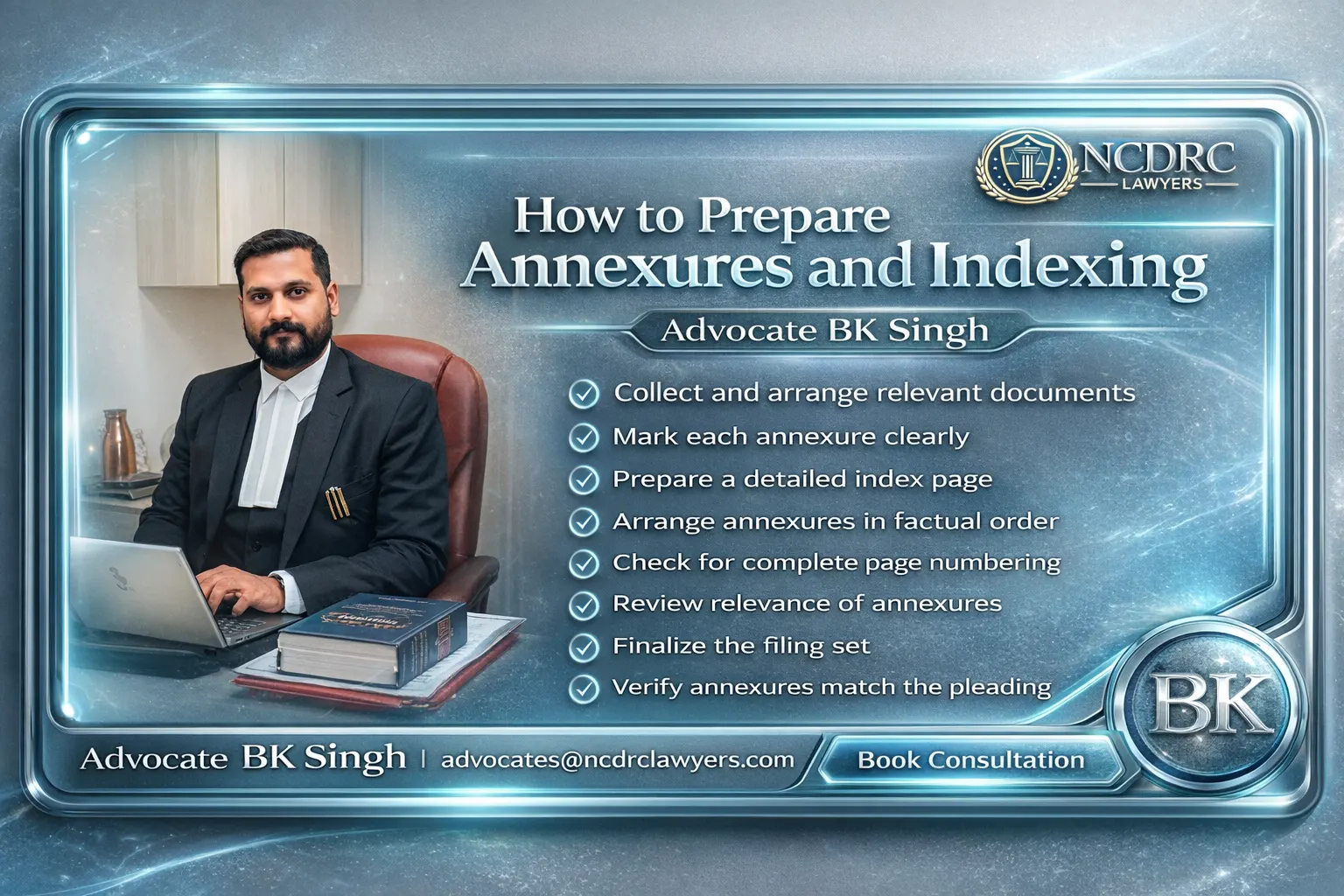
How to Prepare Annexures and Indexing
When the facts of a case are strong but the presentation is weak, it often suffers at the filing counter before it is even heard. In Indian law, especially when it comes to consumer issues, indexing and annexures are not just clerical tasks. They are the most important part of a properly filed case. A well-organized file makes it easy for the court to see the order of events, the supporting documents, and the relief being asked for. This is even more important when there are a lot of documents and not a lot of time before the bench, like in complaints, appeals, revisions, replies, and execution matters. The NCDRC's filing materials have specifically talked about how to handle indexes, annexures, vakalatnamas, and affidavits separately in scanned filing sets. The Delhi High Court's e-filing rules and notices have also stressed the importance of following protocol and making sure that annexures are of high quality.
For middle-class families and small business owners, bad indexing can cause delays that don't need to happen, registry objections, and legal costs that don't need to happen. Even if the claim is real, a missing page number, a wrongly marked annexure, or an incomplete list of documents can slow things down. This is why a lot of people go to NCDRC Lawyers and ask Advocate BK Singh for help with carefully writing, organizing, and getting their documents ready to file. In this area, good legal help isn't just about making the file look official. It is about making the case easy to read, trustworthy, and ready for the next step in the process without any problems.
1. How annexures and indexing can help a legal case
Annexures are the extra documents that come with a complaint, reply, appeal, application, or affidavit. The systematic list that tells the registry and the court what documents are included, in what order they appear, and on which page each document starts is called indexing. They all work together to make the file's structure. Even a real complaint may seem scattered, incomplete, or poorly prepared without that structure.
Annexes and indexes save time for everyone who is involved. The judge, the other party, and the registry should all be able to find the complaint, affidavit, proof of payment, notice, emails, invoices, agreement, order copy, and correspondence without having to look through a pile of papers that aren't marked. A file that is well-organized gives it credibility. It also makes it less likely that an important supporting document will be missed during the admission or hearing process.
2. What kinds of papers should usually be in annexures?
The exact documents depend on the type of case, but in consumer and civil style filings, annexures often include invoices, receipts, contracts, booking forms, proof of payment, emails, WhatsApp chats, legal notices, reply notices, screenshots, bank statements, courier proof, photographs, expert reports, and copies of the orders that are being challenged. If the issue is bad service or unfair trade practice, the annexes should tell the story in a documentary way from start to finish.
A common mistake is attaching every paper you have without thinking about whether or not it is relevant. Courts like things that are complete, but they like things that are clear even more. Instead of adding too many papers that are hard to read or that are repeated, it's better to include only the ones that are relevant and in a logical order. Advocate BK Singh frequently counsels clients to initially adopt the perspective of a reader at the registry counter and subsequently that of a judge. If the file tells the story clearly through documents, the case starts off on a better note.
3. How to put Papers in the right order
The best way to keep papers safe is to put them in order that matches the timeline of the disagreement. Put the index first, then the memo of parties if there is one, the main petition or complaint, the application if there is one, the affidavit, and finally the list of documents and annexures in order of when they were created. This helps the reader understand how the fight started, what happened next, what the complaint was, and what proof supports each step.
For instance, if a small business owner makes a complaint against a service provider, the file might start with the complaint and affidavit, then the agreement, the first invoice, proof of payment, letters showing default, a legal notice, proof of delivery of the notice, a response if there is one, and screenshots that support the complaint. This order makes the case flow naturally. It stops the confusion that happens when an email that comes later is attached to the original contract or when proof of payment comes after the notice of termination.
4. How to properly mark annexures
It is important to clearly and consistently mark each annexure. Annexure A, Annexure B, Annexure C, and so on, or Annexure P 1, P 2, P 3, and so on are common ways to format documents in practice. The most important thing is to be consistent throughout the pleading and the index. If the complaint calls a payment receipt "Annexure B," the same document must be in both the annexure set and the index, with the same marking and page range.
Mistakes in marking create avoidable objections. In the body of the complaint, some parties mention Annexure C, but the annexure bundle skips from B to D. Sometimes, the same email thread is tagged with two different names. These small mistakes may not seem like much, but they can make the filing look less professional overall. NCDRC lawyers usually focus on consistent cross-referencing so that it's easy to find any annexure mentioned in the pleading in the paper book or scanned file.
5. How to make a good index page
A good index should include the serial number, the document's details, the annexure mark, and the page number or range of pages. Each document's description should be short but still useful. It is better to write "invoice dated 15 March 2025 for service payment" instead of just "invoice." It would be better to say "email sent by complainant demanding refund dated 2 April 2025" instead of "writing email." This level of detail makes the file speak for itself.
The index should also show the exact order of the pages in the final set. A lot of filing problems happen when clients make the index too early and then add or remove papers without changing the page numbers. That makes the index not match the real file. It is important to do a final review before filing. In e-filing, the filing protocol is also important because courts may reject or object to document sets that don't follow the rules. The current Delhi High Court e-filing material also stresses the importance of following proper scanning standards, such as OCR direction for annexures.
6. Common mistakes that make the registry object
Annexures that are hard to read are a common problem. People often complain about blurry screenshots, invoices that are only half cut, dark photocopies, and order copies that are missing parts. Another big problem is that there is no continuity. A complaint may mention legal notice, but the annexure file may not have the notice or the proof of mailing. Sometimes parties send screenshots without saying when or where they came from, which makes them less useful as evidence and raises doubts right away.
Another common mistake is putting original pleadings and annexures together in a random order. Some people who are suing forget to sign the affidavit correctly or don't make sure that the annexure numbers in the complaint match the numbers in the index. In consumer and appellate work, these problems make it take longer to get on the list and cost more money. For middle-class people who are already having trouble with money, this delay feels unfair and tiring. Planning ahead saves time and money later on.
7. Why it matters to have professional help with drafting
A lot of clients think that annexures and indexing are easy office tasks, but they actually change how the presentation is put together. Putting the right document in the right place can make an explanation of a limitation, territorial jurisdiction, lack of service, payment trail, or proof of loss stronger. Even a strong complaint can look questionable if the file is not set up correctly. Professional handling helps you figure out what to emphasize, what to group together, and what to leave out because it's not needed.
This is where lawyers who are good at what they do really help. Advocate BK Singh works on document flow, the order of facts, and being ready for procedures in a way that helps clients avoid confusion at the last minute. This advice can often make the difference between a clean filing and repeated mistakes for a family trying to get their money back or a small business trying to get compensation for late service or a faulty supply. NCDRC lawyers don't just write legal documents; they also make sure the case is ready to be presented in court.
8. The best way to get ready for annexures and indexing
Put all of the papers that are important in one folder to begin. Then, put them into groups like order copies, payment documents, legal notice papers, communications, and contract documents. Then, sort them by date and only choose the ones that help your case. First, write the pleading. The pleading will tell you which documents are being used. After that, label each document that was used as an annexure, and make the index only after the last order of pages has been set.
Do one last quality check before you file. Check that all of the annexes listed in the pleading are either physically present or uploaded digitally, that every page is readable, that the page numbers match the index, and that the descriptions of the documents are correct. Also, make sure that the affidavit, vakalatnama, and supporting sets are all in the right format and are complete. The NCDRC filing material has shown that in some cases, the index and other filing components need to be scanned and saved separately. This shows how seriously document organization is taken in tribunal and commission practice.
Reviews from Clients
*****
Rohit Malhotra
I had all my papers, but I didn't know how to organize them correctly for my consumer case. Advocate BK Singh and the team took great care of the annexes and indexing. What seemed like a messy pile of emails, bills, and notices turned into a real case file. Once everything was clearly laid out, I felt a lot more sure.
*****
Meena Vashisht
The fight was already stressing our family out, and the filing process was making things worse. The NCDRC lawyers helped us put together the whole set of documents in a clear and organized way. The index was clear, the annexes were clearly marked, and each paper was in the right place. When you don't have a legal background, that kind of help is very important.
*****
Sandeep Arora
I didn't want my complaint to be delayed because of mistakes in filing, since I own a small business. BK Singh, an advocate, told us which documents were really important and how each annex should back up the facts. The work was useful, honest, and very well organized. It saved me time and kept things from getting too complicated.
*****
Pooja Narain
I had asked other people before, but no one had ever explained indexing and annexures in such a clear and helpful way. Advocate BK Singh went through my file very carefully and took out papers that weren't needed while keeping the important evidence in the right order. The last set looked professional and was easy to understand. I thought that my issue was finally being taken seriously.
*****
Bedi Harsh
The best part was how clear it was. I was worried because my papers were all over the place in emails, WhatsApp messages, receipts, and copies of notices. NCDRC Lawyers helped make everything into a proper legal file with clean indexing and correctly labeled annexures. After that, the process was a lot less stressful.
?FAQs
Q1. What does "annexure" mean in a legal case?
An annexure is a document that goes along with a complaint, petition, appeal, or reply. It backs up what the main pleading says. Some examples are bills, contracts, emails, screenshots, notices, and copies of orders.
Q2. What does "indexing" mean when filing in court?
Indexing means making a structured list of all the papers that have been filed in the case, along with page numbers and descriptions of each document. It helps the court and the registry find documents quickly and understand the file in the right order.
Q3. What is the best way to number annexures?
The pleading, the index, and the annexure set should all have the same numbers or marks. If a document is called Annexure A or Annexure P 1, the same mark should be used on every page of the file.
Q4. Can a case be put on hold because of bad indexing?
Yes, bad indexing can cause registry objections, the need to refile, and delays in listing. Missing page numbers, annexure marks that don't match, and incomplete document descriptions often cause problems that could have been avoided.
Q5. Should annexes be arranged by date?
Putting annexures in chronological order is the safest and clearest way to handle most things. It helps the court understand the disagreement step by step and makes your story more believable.
Q6. Do I need to send in every paper I have?
No, you should only attach documents that are relevant and helpful to the facts and relief you are asking for. Overloading the file with repeated or unrelated papers can make the matter harder to follow.
Q7. Are WhatsApp chats and screenshots real annexures?
When they are clear, dated, and properly labeled, they can be used as supporting annexures. It's always best to file clear copies and make sure they are clearly linked to the facts in the complaint or affidavit.
Q8. Do legal filing documents need to be scanned separately?
Some filing systems and procedures say that indexes, affidavits, vakalatnamas, and annexures should be handled separately. In e-filing, scanning quality is very important. That is why you should take the same care when preparing digital files as you would when preparing a physical book.
Q9. Why do lawyers spend so much time on indexing and annexures?
A poorly organized file can make even a real case look weak. Good annexures and indexing cut down on objections, make the text easier to read, and help the court stay focused on the real issue without getting sidetracked by procedural issues.
Q10. How can NCDRC lawyers help with indexing and annexures?
NCDRC lawyers can help you find the right documents, organize the paper book, make a clean index, mark annexures correctly, and make sure the filing set is organized and ready for court. This is very helpful for regular people and small business clients who don't have to deal with legal documents every day.
There's no reason for concern. There is no difficult-to-understand legalese.
Someone who has helped many people with the same problems gives you clear, honest advice. We want to make the legal process easy to understand and use for everyone.
