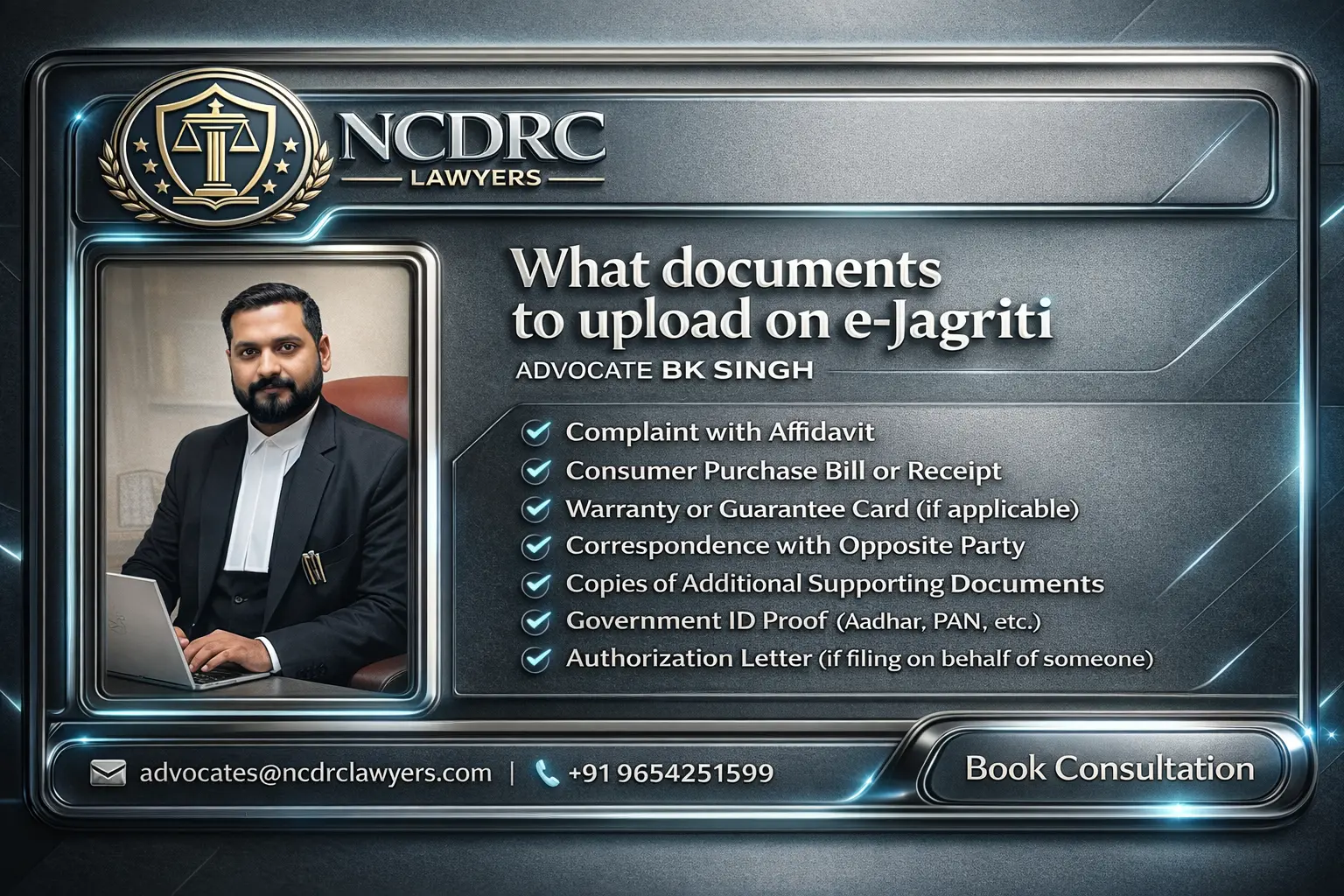
What to Upload to e Jagriti
One of the most important things to think about if you want to file a consumer case online is very simple. What do you need to upload to e Jagriti so that your filing doesn't get delayed, rejected for mistakes, or sent back to you to fix? It's normal to be confused because most people aren't lawyers. A person with a job who has had an insurance claim denied, a family stuck in a dispute over a builder's delay, or a small business owner trying to get paid for a bad service usually has the facts, emails, bills, screenshots, and bank records, but they don't know how to put them together into a proper filing set for the portal. The official e-Jagriti help documents make it clear that the upload stage for a new consumer complaint isn't just about proof. It also needs a structured filing set that includes an Index, a Proforma, a Synopsis, a Memo of Parties, a complaint with a notarized affidavit, and a Vakalatnama, as well as any annexures and IA that may be needed.
That's why planning documents is more important than most people think. e Jagriti is the unified digital consumer justice platform that was launched across the country on January 1, 2025. It combines filing, case management, hearings, and related systems into one interface. In real life, that means a customer can make the right digital documents, upload them carefully, and move the case forward without having to go to the store. It also means that mistakes are easy to see right away. If the complaint is filed after the deadline, the workflow will automatically flag the need for an application for condonation of delay. The portal guidance will also show the monetary jurisdiction based on the amount of money paid.
1. Important papers for a new consumer complaint
Most people who use e Jagriti think that the phrase "documents to upload" means the document set for a new consumer complaint. The official guide for filing a consumer complaint says that the upload stage must include the Index, Proforma, Synopsis, Memo of Parties, Notarized Affidavit, and Vakalatnama. The workflow diagram shows the complaint document itself as a Consumer Complaint with Notarised Affidavit. It also lets you add annexures or supporting documents and any Interlocutory Application that you need. Simply put, this means that your filing should not just be a story with some bills attached. It should be a legal packet that is put together correctly.
This structure makes a big difference in real Indian consumer disputes. Let's say a buyer gave a builder money to book a home but didn't get it on time. The complaint might not go through the scrutiny stage if the person only uploads the allotment letter and payment receipts but not the Index, Memo of Parties, or the properly affirmed complaint papers. In cases of defective products, insurance denials, unfair deductions by travel sites, and complaints about bad service at schools or private hospitals, the same thing happens. NCDRC lawyers and Advocate BK Singh often say that strong evidence alone is not enough. The commission also needs the filing to be in the right format.
2. Proof of identity is required at the time of registration.
You have to make a profile on e Jagriti before you can file the case itself. According to the official onboarding guide, a new user must first enter their mobile number, email address, full name, password, role, and captcha. Then, they must verify their identity by entering a 6-digit OTP that is sent to their registered mobile number and email. The last step of the onboarding process is to upload proof of identity, like an Aadhaar card, PAN card, or driver's license. After that, the user can log in with their email or phone number and a password or OTP.
This is an important difference because a lot of people confuse complaint documents with registration documents. Your proof of identity helps set up and confirm the account. It doesn't take the place of the case papers that are needed for the complaint. So if a client asks, "Why is the portal still asking for more documents when I already uploaded my Aadhaar?" the answer is simple. For onboarding, you need an Aadhaar or PAN. Your Index, Synopsis, complaint papers, affidavit, and evidence are all for the real consumer case. This small difference keeps a lot of first-time users from getting confused.
3. What each of the main filing documents really means
A lot of people who are in court get nervous when they hear names like "Synopsis," "Memo of Parties," and "Proforma" because they sound technical. When broken down correctly, these are not too hard to handle. The Index is the filing's map. The Proforma is the form that the portal needs to file in a certain way. The Synopsis tells the short story of the disagreement, including dates and events. The Memo of Parties shows who is filing and who they are filing against. The complaint with affidavit is the main case, and the Vakalatnama gives the lawyer permission to act on behalf of the client. The official help documents and workflow show that these are the most important papers for filing a complaint.
This is easier to understand with a real-life example. If an online furniture store delivered damaged goods and then stopped answering, the annexes could include the invoice, delivery screenshots, complaint emails, proof of bank transactions, messages refusing to give a refund, and pictures. But those annexures are behind the main set of legal papers. The evidence stays scattered without that core set. This is why a lot of middle-class families and small businesses would rather have NCDRC lawyers, led by Advocate BK Singh, organize the case than upload random files one by one and hope the portal accepts them.
4. What should be in annexes and supporting evidence
The official guide says that after users have filed the required papers, they can upload annexures with the correct title and, if necessary, an IA application. This might sound easy, but it's one of the most important parts of the whole process. Annexures are where you keep your evidence. Invoices, receipts, agreements, order confirmations, warranty cards, emails, WhatsApp chats, courier records, call records (if they are legally available), cancellation requests, bank statements, screenshots of app or website pages, and any notice sent to the other party before the event are all things that are usually included.
The most important thing is not to send fifty screenshots that don't go together. Each annexure should have a clear title and help explain a certain part of the complaint. For instance, Annexure 1 could be the invoice, Annexure 2 could be the proof of payment, Annexure 3 could be the complaint email, Annexure 4 could be the refusal reply, and Annexure 5 could be the legal notice or final reminder. This way of organizing the documents makes the case easier to read and harder to ignore. That is the difference between filing based on emotions and filing based on strategy. It's also one of the reasons why clients often ask NCDRC Lawyers for help with careful drafting.
5. Know your limits and where you can upload things before you do.
A very common mistake is to spend hours making PDFs before checking to see if the complaint is on time and finding the right commission. According to the official consumer complaint process for e Jagriti, a complaint must be filed within two years of the cause of action. If it is not filed within that time frame, an application for condonation of delay must be made. The same workflow also shows that the amount of money paid determines the jurisdiction, with DCDRC covering amounts up to 50 lakhs, SCDRC covering amounts from 50 lakhs to 2 crores, and NCDRC covering amounts over 2 crores.
This is very important in disputes over property, insurance, vehicles, education, medical care, and high-value commercial goods. A person may have perfect evidence, but they could still get in trouble if they file the case in the wrong place or don't explain the delay. These technical details can make the difference between a small business owner who paid a lot of money to a service provider and a homebuyer whose timeline has gone badly. Advocate BK Singh usually sees these as pre-filing checkpoints because the right documents are only useful when they are filed in the right place and in the right way.
6. When the papers you need for appeals and later stages change
Another big reason people get confused is that the documents you need to file change depending on what you're filing. There is one official list on e Jagriti for each type of complaint: a new consumer complaint, a First Appeal, a Revision Petition, a Review Application, an Execution Application, and an Interlocutory Application. The First Appeal guide has an Index, a Proforma, a Synopsis, a Memo of Parties, a Notarized Affidavit, a First Appeal with Affidavit, a Certified State Commission Order, and a Vakalatnama, for example. The Revision Petition guide has official copies of orders from the State Commission and the District Commission. The Review Application guide says that the review application must include a notarized affidavit and a certified copy of the National Commission's order. The Execution Application guide says that the execution application must include a notarized affidavit and a copy of the relevant order.
First, ask yourself one simple question before you look online for what documents to upload to e Jagriti. Am I making a new complaint, an appeal, a case for execution, or an application in a case that is already open? That one answer changes the list of things to upload. This is where legal advice becomes really useful because a lot of people use the wrong document checklist that they copied from a different stage. NCDRC lawyers often see cases where someone tries to file an execution application with only old complaint papers or a review application without the certified copy of the relevant order. This causes delays that aren't necessary.
7. How to get your papers ready so that the filing is cleaner and stronger
The process of using the portal is digital, but the legal reasoning behind the papers still needs to be strict. Your PDFs should be easy to read, follow a logical order, and have clear names. The official screenshots in the help files show that there are separate upload spaces for the main filing papers and for IA documents and other documents. That means the platform wants things to be organized, not messy. It's always safer to make the complaint set first, then the evidence set, and then any applications that might be needed because of delays, interim relief, or other procedural problems.
Think of two people who are unhappy with the same travel company in everyday language. One person uploads screenshots that are mixed up, have names that aren't clear, and don't have a timeline. The other uploads a neat set that includes an Index, a Synopsis, a complaint affidavit, a Memo of Parties, and annexures with titles that match the story. The second filing looks more believable and easier to check right away. People often don't give that practical presentation value enough credit. It doesn't make the claim on its own, but it has a big impact on how quickly the matter moves. This is why people often choose Advocate BK Singh: document discipline cuts down on confusion right from the start.
8. Why regular families and businesses need to upload things correctly
For middle-class people, a rejected or faulty filing is more than just a technical problem. It means more waiting, more follow-up, more stress, and sometimes the feeling that only people who already know the system can get justice. For small businesses, especially service providers, distributors, and buyers who have to deal with broken machines, shipping problems, or unfair behavior on platforms, mistakes in documents can make a perfectly good claim less strong. e Jagriti was designed to simplify filing, allow tracking, and reduce physical dependence on paper processes, but the user still has to upload the right documents in the right way.
That's why the best thing to do is not to ask what one document is enough. What full filing packet do I need for my stage of the case is a better question. The portal is a lot less scary once that is clear. NCDRC Lawyers and Advocate BK Singh can help clients turn a bunch of papers into a legally presentable complaint set. This is often the difference between being confused and being sure. Anger or a complaint alone do not make a strong case for a consumer. It is built on the right papers, a clear timeline, and carefully uploaded proof.
Client Reviews
*****
Raghav Sinha
I had bills, emails, screenshots, and proof of payment, but I didn't know how to put them all together on e Jagriti. The team helped me understand the difference between the main complaint papers and the supporting annexes by explaining each document in simple terms. After talking to Advocate BK Singh, I felt heard, guided, and much calmer.
*****
Neha Bedi
My problem seemed simple at first, but the portal requirements made me feel like I was going to lose it. The lawyers at NCDRC helped me put the file together in a way that finally made sense. I knew what should go where and why, so I didn't just upload random files. That clarity helped me save time and a lot of stress.
*****
Puneet Arora
I had already tried to prepare the filing myself, but I didn't know I was missing important papers. The advice I got was useful, clear, and easy to follow. BK Singh Advocate didn't use hard-to-understand language and made the whole thing seem doable for a regular person.
*****
Shweta Nair
The thing that impressed me the most was the patience. I got the right answers to all of my questions about the affidavit, annexures, and complaint papers. I never felt like I was in a hurry. When people are already upset because of a consumer dispute, calm legal help is very important, and that's what I got.
*****
Imran Qureshi
As a small business owner, I can't afford to make the same filing mistakes over and over. I needed someone who knew how to plan and write down what they did. The help I got was honest, clear, and well-organized. It made me feel good that my case was finally being handled the right way.
?FAQs
Q1. What papers do you need to file a new consumer complaint on e-Jagriti?
The official help material lists the main documents needed for a new consumer complaint as the Index, Proforma, Synopsis, Memo of Parties, Notarized Affidavit, and Vakalatnama. The workflow also shows that the complaint with the notarized affidavit is a core filing paper. You can add annexures and IA documents when you need to.
Q2. Do I need an Aadhaar number to file on e-Jagriti?
You need to show proof of identity, like an Aadhaar, PAN, or driver's license, when you register on the site. Aadhaar is one option that is accepted, but the onboarding guide also lists other forms of identification.
Q3. Is proof of identity enough to finish my case filing?
No. You need identity proof to make and check your user profile. You still need the complaint document set and any supporting annexes that go with the type of case you are filing.
Q4. Can I add invoices, screenshots, emails, and proof of payment as attachments?
Yes. The official complaint guide lets you add annexures with the right title, which is where you usually put supporting documents. People usually upload practical proof like invoices, payment receipts, emails, screenshots, and letters in that annexure section if it backs up the complaint.
Q5. Do I need a lawyer to file on e Jagriti
The platform allows consumers to register and file digitally, but the help documents also include a Vakalatnama field and advocate selection steps where an advocate is engaged. So a lawyer is not the only way to use the portal, but legal help can be valuable when the matter is document heavy or strategically sensitive.
Q6. What is a Synopsis in e Jagriti filing
A Synopsis is the short and clear summary of the dispute along with the important dates and events. The official workflow specifically refers to Synopsis with List of Dates and Events as part of the mandatory complaint papers.
Q7. What if my consumer complaint is older than two years
The official workflow states that a consumer complaint should be filed within two years of the cause of action. If it is beyond that period, an application for condonation of delay is required.
Q8. Which commission should I choose on e Jagriti
The complaint workflow maps pecuniary jurisdiction based on paid consideration amount. DCDRC is shown up to 50 lakhs, SCDRC from 50 lakhs to 2 crores, and NCDRC above 2 crores. The correct forum should be checked carefully before final upload.
Q9. Are the documents the same for appeal and execution cases
No. The official help documents show different document lists for First Appeal, Revision Petition, Review Application, Execution Application, and IA filing. For example, appeal and revision matters require order copies that are not part of a normal fresh complaint filing.
Q10. What happens after I upload the documents and submit
The official complaint filing guide says that after preview and final submission, the system generates a reference number and submits the case to the respective commission. The workflow also shows scrutiny, payment where applicable, and further case movement after acceptance.
There's no reason for concern. There is no difficult-to-understand legalese.
Someone who has helped many people with the same problems gives you clear, honest advice. We want to make the legal process easy to understand and use for everyone.
