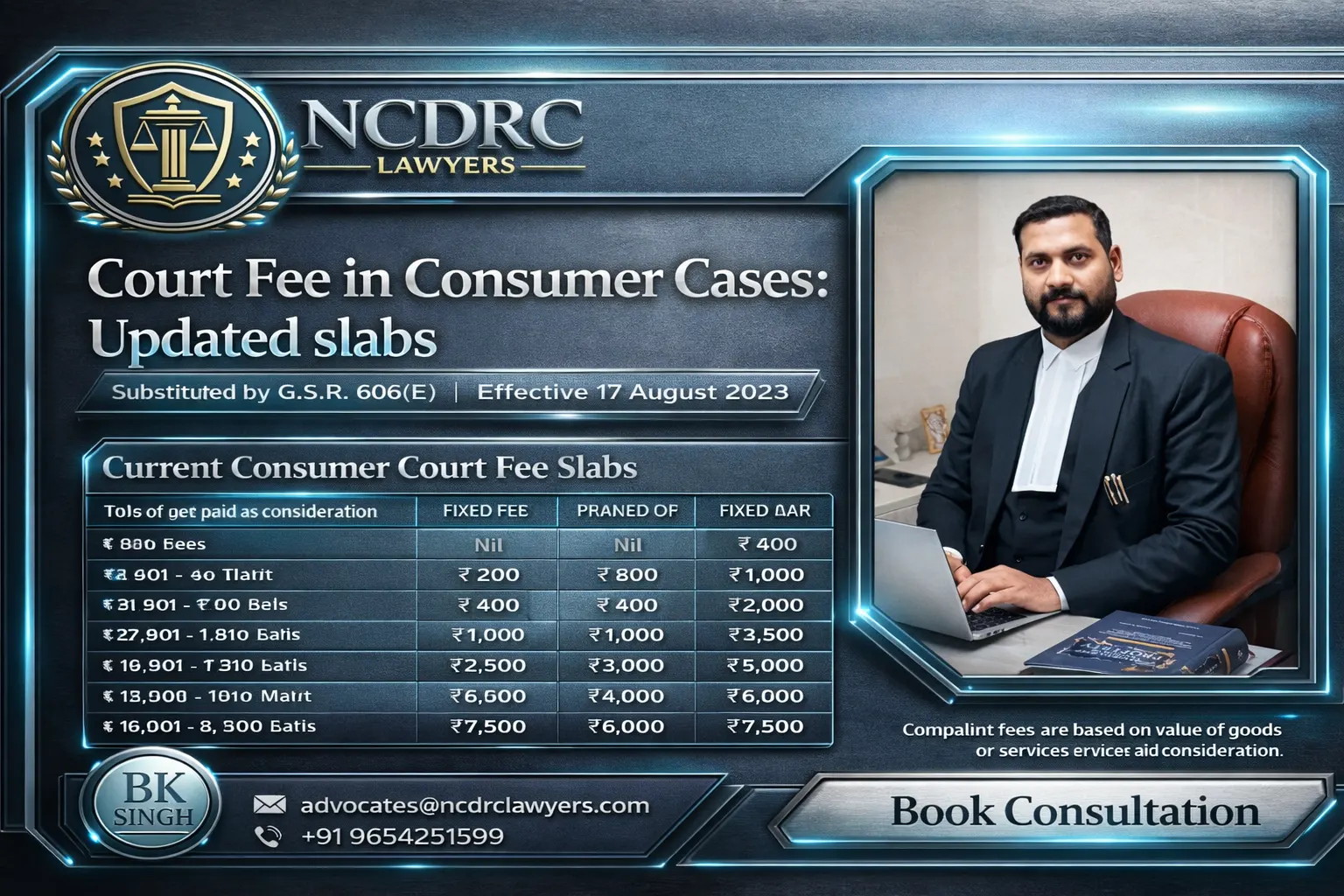
Court Fee in Consumer Cases Updated Slabs
One of the first things many families and small business owners want to know before filing a consumer case is how much the court fee will be. The good news is that consumer law in India keeps filing fees low, and the current schedule is clearly laid out in the Consumer Protection framework. G.S.R. 606(E) replaced the current fee table for complaints on August 17, 2023. The rule itself links the filing fee to the value of the goods or services that were paid for.
This is very important in real life. A middle-class person who is dealing with a builder delay, a hospital billing problem, a broken car, a failed insurance service, or a business owner who is getting bad service from a vendor shouldn't have to guess the cost from random blogs. Advocate BK Singh often sees clients at NCDRC Lawyers who are confused by old charts that are still going around online. Reading the current slab carefully, picking the right Commission, and filing with the right documents from the start is the safer way to go.
1. current fee levels for consumer courts
The current fee for filing a consumer complaint is not an unlimited amount. The Consumer Protection Rules say that there is a set fee schedule, and the complaint must be sent with the correct fee. The 2020 Rules PDF itself says that G.S.R. 606(E) replaced the fee table on August 17, 2023.
The fee is zero up to Rs 5 lakh under the current slab. The fee is Rs 200 for amounts between Rs 5 lakh and Rs 10 lakh. It costs Rs 400 for amounts between Rs 10 lakh and Rs 20 lakh. It costs Rs 1,000 for amounts between Rs 20 lakh and Rs 50 lakh. It costs Rs 2,000 for amounts between Rs 50 lakh and Rs 1 crore. It costs Rs 2,500 for amounts between Rs 1 crore and Rs 2 crore. It costs Rs 3,000 for amounts between Rs 2 crore and Rs 4 crore. It costs Rs. 4,000 for amounts between Rs. 4 crore and Rs. 6 crore. It costs Rs 5,000 for amounts between Rs 6 crore and Rs 8 crore. It costs Rs 6,000 for amounts between Rs 8 crore and Rs 10 crore. It costs Rs 7,500 above Rs 10 crore.
2. Which consumer commission should you contact?
The current money limits for the District Commissions are up to Rs 50 lakh, for the State Commissions are above Rs 50 lakh and up to Rs 2 crore, and for the National Commission are above Rs 2 crore. This is what the official Department of Consumer Affairs and NCDRC information shows about the working forum structure.
One important practical point is that the fee table and the statutory scheme both use the phrase "value of goods or services paid as consideration" over and over again. In short, that means you should carefully plan your filing strategy instead of just raising the compensation amount in the prayer clause. This is when it really helps to get advice from NCDRC Lawyers and Advocate BK Singh, especially if the client isn't sure if the case should be heard at the District, State, or National level.
3. How the fee works in real life
For example, in a simple household. If a customer paid Rs 4.8 lakh for goods or services and now wants a refund, compensation, and court costs because the product didn't work or the service wasn't good enough, the current filing fee is zero. The filing fee goes down to Rs 200 if the amount paid was Rs 7.5 lakh. If you paid Rs 18 lakh, the fee goes up to Rs 400.
Now let's talk about things that are a little bigger and that small businesses and upper-middle-class families often deal with. If a business paid Rs 32 lakh for machinery or commercial services and the dispute is covered by consumer law, the filing fee is Rs 1,000. The fee is Rs 2,000 if the payment was Rs 72 lakh. The fee is Rs 2,500 if it was Rs 1.4 crore. This is why it's more important to get the paid consideration right than to guess how much you lost.
4. Why people still get confused about new slabs
A lot of people are confused because older articles and copied charts still show the old District Commission, State Commission, and National Commission breakup with the old fee schedule. The official Rules PDF itself shows the older table below the footnote and clearly says that G.S.R. 606(E) replaced the table on August 17, 2023. In other words, someone who is using a pre-amendment chart without seeing that footnote might be using old information about fees.
That mistake could cause delays at the filing counter or during the review. A strong complaint can still get objections that could have been avoided if the wrong forum is chosen or the fee is based on the wrong schedule. For middle-class clients who are already dealing with bad service, medical negligence costs, builder delays, or insurance disputes, clean filing makes a big difference.
5. Other things clients should know about filing
The Rules say that the complaint fee can be paid by crossed demand draft, crossed Indian Postal Order, or electronically in a way that the Commission has set up. The Consumer Protection Act also says that most complaints should be made within two years of the date the cause of action arises. However, complaints that are made after this time may still be accepted if there is a good reason and the reasons are recorded.
The Rules also say that complaints should be resolved as quickly as possible, within three months of the other party receiving notice, if no analysis or testing is needed, and within five months if analysis or testing is needed. That is a goal set by law, not a promise, but it shows that the consumer law wants to help people faster than regular civil litigation.
6. How NCDRC lawyers and Advocate BK Singh can help
When clients bring in invoices, receipts, booking forms, emails, warranty papers, or service agreements, the first real legal task is not to write something dramatic. It is a correct classification. A careful lawyer must find the right court, figure out the right fee, decide if the case falls under consumer law, and write the relief in a way that is both practical and legally sound. That early clarity often saves more time than harsh words.
NCDRC lawyers and advocate BK Singh focus on helping people with real-world legal problems like these. When clients have problems with builders, service, product defects, unfair billing, insurance claims, hospitals, or consumer appeals, the most important thing is to have the right paperwork, calm advice, and a filing plan that won't fall apart because of technical issues. That kind of structured approach is often the difference between being confused and knowing what to do next for regular Indian consumers and small businesses.
Reviews from Clients
*****
Rohit Mehra
I didn't know if I should file my complaint with the District Commission or the State Commission, and I didn't know how to figure out the fees. Advocate BK Singh explained the slab to me in very simple terms, looked over my papers carefully, and showed me the right way to go legally. After that, the whole thing felt a lot less stressful.
*****
Neha Suri
I had a problem with a delayed housing service, and I had already gotten conflicting advice from different people. NCDRC lawyers helped me figure out the right place to file, how much it would cost, and which papers I really needed. At every step, I felt like I was being listened to, respected, and given the right advice.
*****
Amit Deshpande
The most important thing to me was the practical approach. Advocate BK Singh didn't make big promises. Instead, he focused on the value paid, how easy it would be to keep the complaint going, and the right way to file it. That honesty made me feel better and kept me from making mistakes when I filed.
*****
Shalini Verma
I had never filed a consumer case before, and the fee chart I found online was hard to understand. The NCDRC Lawyers team clearly explained the new slabs to me and helped me figure out what was current and what was out of date. Their advice was professional, patient, and really comforting.
*****
Faizan Khan
I needed clear and quick legal help as a small business owner. Advocate BK Singh looked over my papers, told me how much the court fees were, and gave me a clear plan instead of vague ideas. I thought I was working with someone who knew both the law and how hard it is for clients to deal with stress.
?FAQs
Q1. How much does it cost to go to court for a consumer case worth up to Rs 5 lakh?
Under the current rules, there is no fee to file a consumer complaint up to Rs 5 lakh.
Q2: How much does it cost to file a complaint in consumer court if the amount is between Rs 5 lakh and Rs 10 lakh?
The fee for this slab is Rs 200, as stated.
Q3. If the value is between Rs 10 lakh and Rs 20 lakh, how much is the fee?
The current fee for that range is Rs 400.
Q4. What is the fee for consumer complaints that are more than Rs 20 lakh but less than Rs 50 lakh?
The fee for that slab is Rs 1,000.
Q5. Which consumer forum deals with cases worth up to Rs 50 lakh?
The District Consumer Commission is in charge of these kinds of things right now.
Q6. Which court deals with consumer cases worth more than Rs 50 lakh and up to Rs 2 crore?
The State Consumer Commission is in charge of these kinds of cases right now.
Q7. Which court takes care of consumer cases worth more than Rs 2 crore?
The National Consumer Commission now handles cases worth more than Rs 2 crore.
Q8. Is the fee based on the amount of compensation claimed or the price paid for goods or services?
The fee schedule's legal language uses the value of the goods or services paid as consideration. That's why the calculation should be done carefully and not just based on the amount asked for in the prayer clause.
Q9. Is it possible to file a complaint online or pay for it electronically?
The Rules say that the Commission can set up electronic payment options, and they also say that electronic filing is possible as long as the Commission lets people know.
Q10. Is there a deadline for filing a complaint as a consumer?
Yes. The Act says that a complaint should usually be filed within two years of the cause of action, but it can be late if there is a good reason.
There's no reason for concern. There is no difficult-to-understand legalese.
Someone who has helped many people with the same problems gives you clear, honest advice. We want to make the legal process easy to understand and use for everyone.
